DevOps Automation Services for Reliable Delivery
Explore our devops automation services, including CI/CD pipelines and automated deployments, designed to enhance your software delivery process.
What good DevOps changes
Every production release follows a tested and scripted pipeline.
Automated releases
Production deployment occurs within days of merging code, not weeks.
Lead time target
day
Automated tests and staging environments identify issues before customers encounter them.
Change failure target
Automatic rollback and clear alerts help resolve incidents swiftly.
Recovery target
hr
We track four delivery metrics for every team we collaborate with.
Transitioning from manual deployments to a dependable delivery pipeline.
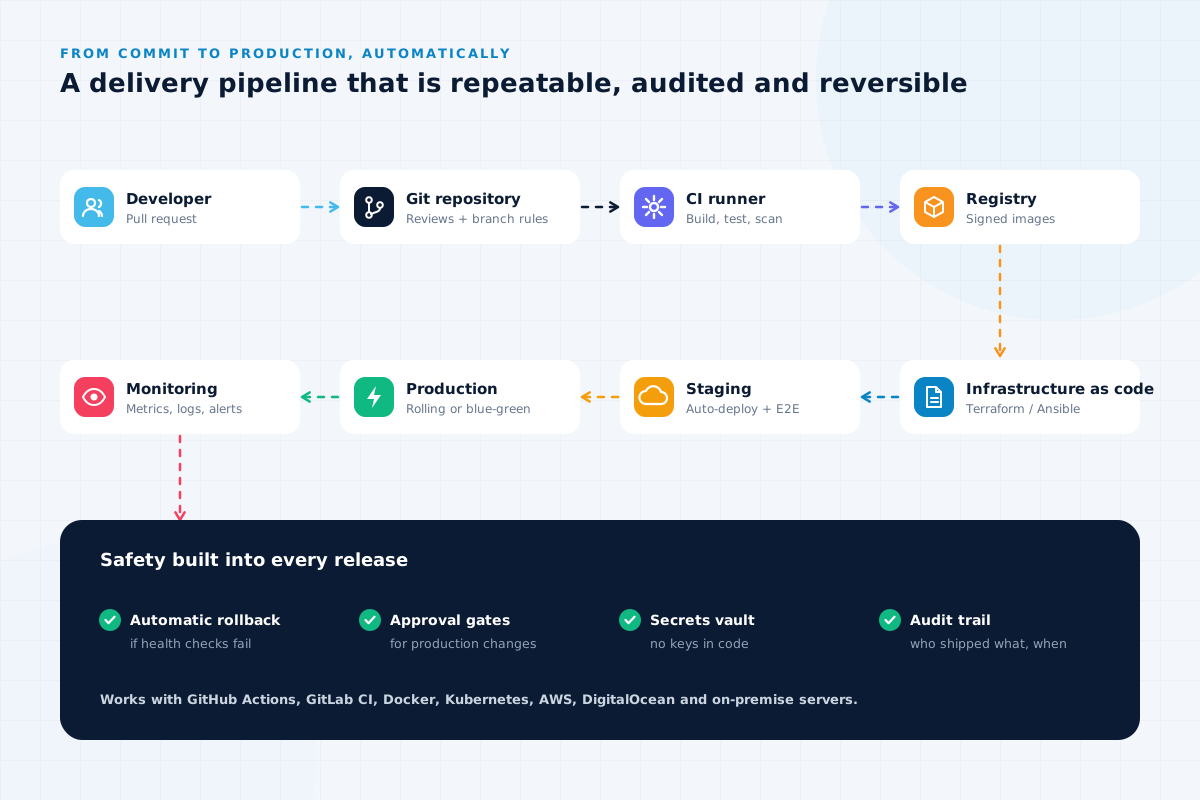
A CI/CD and infrastructure-as-code workflow that covers everything from pull requests and code reviews to CI builds, signed registries, staging, production, monitoring, rollbacks, and approval gates.
If launching a new version feels like a late night, with a mental checklist and crossed fingers, you are likely experiencing slow delivery and unnecessary outages. DevOps encompasses the practices and tools that transform software releases into a routine process, in the best way possible.
We develop CI/CD pipelines that automatically build, test, and perform security scans on every change, package applications in Docker containers, and deploy them to staging and production environments with a single approval. We define servers and cloud resources as code using Terraform or Ansible, ensuring that environments can be precisely recreated and every change is subject to review like application code.
Designed for Your Team, Not a Textbook
We begin with your existing tools and workflows, automating the most challenging steps first. Whether you manage a single web application or a collection of microservices, our aim remains consistent: to provide quicker feedback for developers, safer releases for users, and enhanced visibility for managers.
right
DevOps and automation services
Automated build, test, scan, and deployment pipelines using GitHub Actions, GitLab CI, or Jenkins, with approvals integrated where necessary.
CI/CD pipelines
Applications are packaged into small, secure images that operate consistently across laptops, staging, and production environments.
Containerisation with Docker
Managed Kubernetes or Docker Compose configurations featuring auto-scaling, health checks, and rolling updates.
Kubernetes and orchestration
Cloud resources, networks, and servers are defined using Terraform and Ansible, ensuring they are versioned, reviewed, and repeatable.
Infrastructure as code
Centralised logs, metrics, dashboards, and alerts facilitate quick identification and explanation of issues.
Monitoring and logging
We integrate dependency and image scanning, manage secrets, and conduct security checks directly within the pipeline.
DevSecOps
Choose a specific area for improvement, or allow us to establish a comprehensive delivery platform.
How we introduce DevOps into your team
We analyse the current process of getting code from developers to production, identify time losses, and highlight the main risks.
Delivery assessment
1 week
We automate the build and testing processes for your primary application, deploying to a staging environment with every code merge.
First pipeline
1 to 2 weeks
Applications are containerised and environments are defined as code, ensuring that staging environments reflect production accurately.
Containers and environments
2 to 3 weeks
We facilitate zero-downtime deployments, incorporating health checks, approval gates, and one-click rollback options for live production.
Safe production releases
1 to 2 weeks
We integrate metrics, logs, and alerts, providing dashboards for developers and a straightforward health overview for managers.
Observability
1 to 2 weeks
We empower your team to manage and enhance the pipeline, or we can run it for you on a monthly basis.
Handover and coaching
Ongoing
We implement incremental changes that provide value within weeks, all while maintaining ongoing feature development.
DevOps tools we work with
Pipelines that run on every change.
CI/CD
Portable, reproducible runtime environments.
Containers
Environments you can rebuild from a repository.
Infrastructure as code
Public cloud or your own servers.
Cloud
Know what is happening and why.
Observability
Security checks as part of every build.
Security
We utilise proven open-source and cloud-native tools, carefully selected to suit your team's needs and budget.
We measure success by delivery performance, not by the tools that are installed.
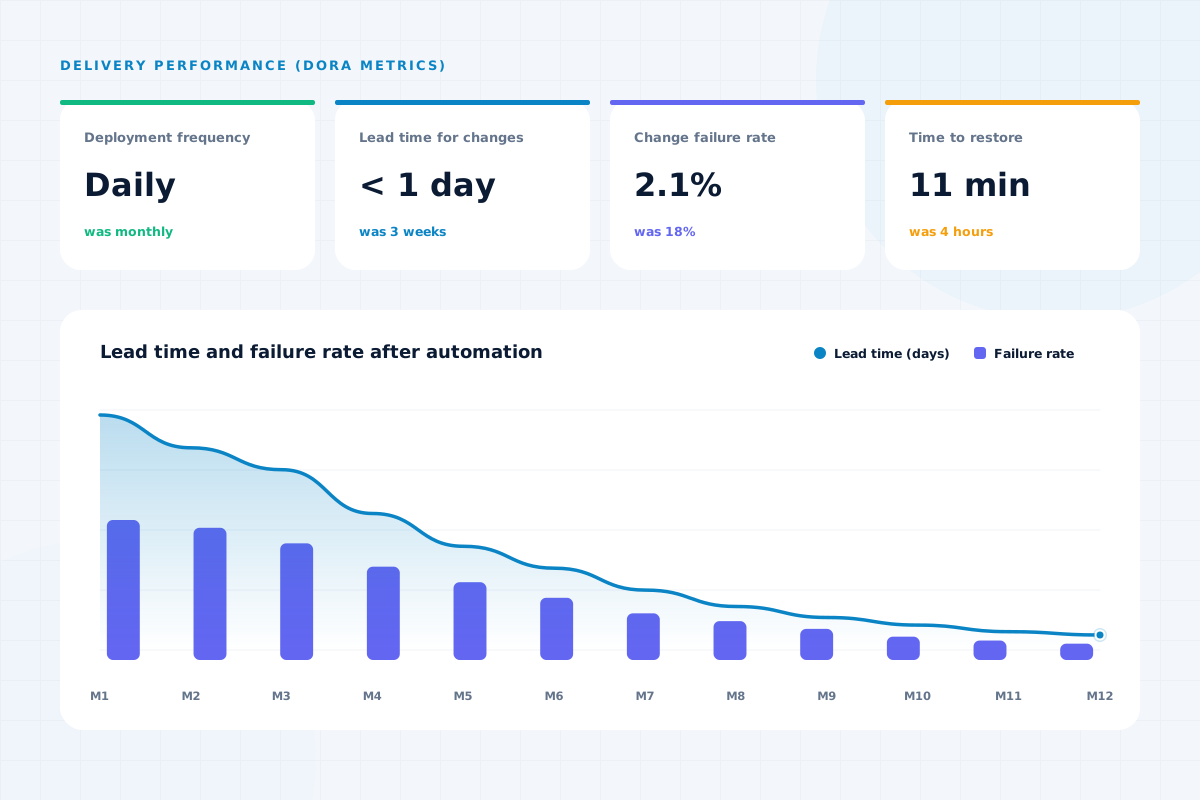
Our DevOps delivery performance dashboard tracks deployment frequency, lead time, change failure rate, and time to restore, along with a twelve-month trend.
We assess DevOps performance using four key indicators commonly recognised in the industry, referred to as the DORA metrics, and we begin tracking them from the very first week.
- Deployment frequency: the rate at which you can safely release updates to production.
- Lead time for changes: the duration it takes for a merged change to reach users.
- Change failure rate: the frequency with which a release results in an issue that requires resolution.
- Time to restore: the speed at which service is restored when an issue arises.
Observing consistent improvements in these metrics each month indicates that your investment is yielding results.
left
Why teams choose LogixInventor for DevOps
We also write application code, ensuring that our pipelines align with developers' needs without causing disruptions.
Developers first
For a single small application, we advise using the simplest setup that effectively addresses your requirements.
Pragmatic scope
We provide runbooks, diagrams, and training to help your team understand and take responsibility for what we create.
Documented and teachable
With versioned infrastructure and rollback options, you can experiment confidently while minimising the cost of errors.
Every change reversible
By right-sizing, auto-scaling, and cleaning up unused resources, we help you manage your monthly cloud expenses.
Cloud cost awareness
Our team in Karachi collaborates effectively with clients in the Gulf, the UK, and Europe.
Hours that overlap with yours
We are practical engineers who actively build and manage applications.
Ways to work with us on DevOps
DevOps assessment
We conduct a one to two week review of your delivery process, infrastructure, and risks, providing a practical roadmap.
Understanding where you stand
We conduct a one to two week review of your delivery process, infrastructure, and risks, providing a practical roadmap.Book an assessment
Pipeline implementation
We create your CI/CD pipelines, containers, infrastructure code, and monitoring systems, followed by comprehensive training.
Most chosen
Teams ready to automate
We create your CI/CD pipelines, containers, infrastructure code, and monitoring systems, followed by comprehensive training.Automate my releases
Managed DevOps
We manage and enhance your pipelines and infrastructure monthly, acting as an extension of your team.
Teams without an ops specialist
We manage and enhance your pipelines and infrastructure monthly, acting as an extension of your team.Talk about managed DevOps
From a targeted assessment to a fully managed delivery platform.
DevOps and automation: frequently asked questions
We automate the process from code to production, covering building, testing, security checks, deployment, infrastructure, and monitoring. This approach leads to quicker and safer releases, reducing the likelihood of late-night emergencies.
What role does a DevOps engineer play in my business?
That is often not the case. Many business applications operate effectively on a limited number of well-managed Docker hosts. Kubernetes becomes advantageous when you have numerous services, significant scaling requirements, or multiple teams involved. We advise using it only when the benefits justify the added complexity.
Do we need Kubernetes?
A typical web application pipeline can usually be operational within one to two weeks. A comprehensive setup that includes containers, infrastructure as code, and monitoring typically requires six to ten weeks, delivered in phases.
How long does it typically take to establish a CI/CD pipeline?
We implement changes progressively, in conjunction with regular feature development. Developers often experience quicker feedback and reduced manual processes within the initial sprint.
Will this disrupt our developers?
Indeed, we collaborate with GitHub, GitLab, and Bitbucket, as well as the leading cloud providers and on-premise servers, to enhance your existing infrastructure wherever it is beneficial.
Are you able to integrate with our current cloud services and tools?
Confidential information is stored securely in a secrets manager or within the encrypted storage of the CI platform. Access is restricted based on user roles, and pipelines are monitored for any keys that may have been unintentionally committed.
What measures do you take to ensure the safety of secrets and credentials?
In most cases, yes. Adjusting server sizes, scheduling non-production environments, and eliminating unused resources can significantly lower monthly expenses.
Can you help us lower our cloud expenses as part of the project?
Answers for engineering leaders and business owners alike.
Feel free to reach out to an engineer directly via email, phone, or WhatsApp. You will receive a straightforward answer, not a sales pitch.
Still have a question?
Talk to our team
Make your next release a non-event
Share how your team currently handles deployments and the challenges you face. We will identify the fastest path to automated and dependable releases.
Share how your team currently handles deployments and the challenges you face. We will identify the fastest path to automated and dependable releases.Automate my releases
tel:+923333836851
Call +92 333 3836851